

What Actually Kept Us Going (Hint: it was not grit)
People ask us what the hardest part of building Clermont Partners was. They usually expect the sale process. Or a nightmare client. Or the first time payroll got tight.
It was none of those. It was one week in our first year, before we had much of anything to lose except the idea itself.
Some background. We left a big consulting firm in January 2015 to start Clermont. Victoria jumped first. Beth was stuck serving out a garden leave, which meant she was contractually benched. She could think about the business. She could not work on it. So for the first stretch, Victoria was running a brand-new firm essentially alone.
Then our former employer sued. Not just the company. Beth, personally. They hired an expensive New York litigator, silk pocket square and all, whose entire assignment was to scare two women out of launching a firm. The suit itself was not a surprise. We had planned for a legal fight. What we had not planned for was how it would feel.
Here is the week we want to tell you about.
The case reached depositions. Victoria was pregnant with twins, and not a little pregnant. Days from delivering. As we write in Chapter 1 of Entrepreneur Like a MOTHER, Moms, Media, and the Boys Club:
“She was deposed on the Friday before she gave birth to Kate and Vivi the following Monday.”
Read that sentence again. Deposed Friday. Delivered twins Monday.
That same week, Beth was sitting at home, named in a lawsuit she could not fight publicly, legally barred from helping the business that had her savings and her name on the line. Our start-up capital was flowing in one direction, toward lawyers. Every dollar we had set aside to build the firm was being spent defending our right to have one. As the same chapter puts it:
“In the end, we kept the clients but lost a whole lot of start-up capital to the hefty legal defense bills and ultimate settlement.”
So that was the picture. Professionally, we were being sued into the ground before we had a logo we liked. Victoria was about to deliver two babies and feeling every bit of the summer heat.
If there was ever a week to fold, that was it. Nobody would have blamed us. Folding was literally the point of the lawsuit. That litigator was not hired to win damages. He was hired to make quitting feel like the reasonable option.
What made it hardest was not any single piece. We had survived hard weeks in business before. It was the simultaneity. The business crisis and the personal crisis did not take turns. They arrived together, they compounded, and they made clear thinking impossible. That is the part nobody prepares you for. Every founder plans for problems. Nobody plans for three problems at once while days from a delivery room.
What actually kept us going
Not motivation. We want to be precise about this, because the standard version of this story ends with a line about grit or believing in yourself, and that version is useless to you.
We did not feel gritty that week. We felt sick. What we had instead of motivation was a way of making decisions when we could not think clearly. It was crude at the time. We sharpened it over the years that followed, and it eventually became the method we lay out in Chapter 8 of the book, Power Move #5: Respect the Pivot. But the core of it was already carrying us through that first year, and it comes down to two questions.
Question one: What is the actual question we are trying to answer right now?
Panic writes big questions. Should we give up? Is this whole thing a mistake? What if we lose everything? Big questions have no answers, which is exactly why your brain loves them at 2 a.m. You can spin on them forever and never produce a single decision.
So we forced ourselves to shrink the question. The actual question that week was not whether to quit. It was: can we keep our clients through a settlement? That question has an answer. It has a lawyer’s opinion attached to it, a dollar range, a yes or a no. We asked it, and the answer came back yes. Expensive and painful, but yes. And once you have answered one answerable question, you can ask the next one.
Question two: What is the smallest possible next move?
Not the winning move. Not the move that fixes everything. The smallest one.
For Victoria that Friday, the smallest next move was getting through eight hours of deposition questions without handing the other side anything. That was the whole job. Not the lawsuit, not the firm, not the birth plan. Eight hours of questions. Then, three days later, two babies.
For Beth, benched by the garden leave, the smallest next move was even smaller. Write the list of everything she would do the day her leave expired, so that when she could finally work, she would not waste a single morning deciding where to start.
This is the part we need you to hear: neither of those moves required confidence. Neither required us to feel good about the business or see the future. They only required the next eight hours.
Years later, this became a formal habit at Clermont. Every week we looked at what we had tried, and as we write in Chapter 8:
“At the end of every week, we doubled down on elements that showed promise and abandoned the losers.”
Small moves, reviewed weekly, adjusted constantly. The chapter compresses it into five words:
“The secret is staying in motion.”
Motion generates information. Information makes the next question answerable. That loop is the whole system, and it works the same in a crisis week as it does in a growth quarter.
One more thing about the feelings
We are not telling you to suppress anything. Chapter 8 includes a step we call feel the feels, then file them, and both halves matter. Victoria cried that year. Beth raged. We let it happen, on a schedule, usually on the phone with each other after the kids went down. Then we filed it and asked the two questions again. As the book says, moving on from a tough moment does not mean erasing it. The lawsuit still comes up over wine a decade later. But it stopped making our decisions for us almost as soon as we learned to shrink the question.
Why this matters for your hard week
You will have one. Maybe you are in it now. The business problem and the personal problem will arrive together, because that is how it works when the founder and the mother are the same person.
When it happens, do not try to think big. You will not be able to, and the attempt will cost you days. Shrink the question until it has an answer. Make the smallest move that produces information. Repeat until you can breathe.
That is not inspiration. It is a procedure. Procedures work when you are too tired for anything else, which is precisely when you need one.
The two questions are the short version. The full method is in Chapter 8 of the book, Power Move #5: Respect the Pivot.
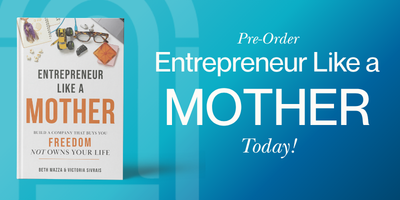
Entrepreneur Like a MOTHER comes out September 22. The full story of both sales, including the parts that still make me wince, is in the book.
P.S. If someone you know is in a hard week right now, forward this to her. No pep talk attached. Just this.
New here? Founders Files is a weekly letter for women building real businesses around real families. Subscribe to Founders Files here