
Advance copies of Entrepreneur Like a MOTHER went out a few weeks ago. Most of what comes back at that stage is polite. Nice writing. Great stories. Cannot wait to buy one for my sister.
Then two notes came in that we have not stopped talking about.
The first:
“I stopped reading and started building my revenue model immediately.”
She quit in chapter 4. She has still not finished the book. That is the best review we have gotten, and we mean it.
A book that gets finished is a nice book. A book that gets put down because the reader had to go do something is one that worked. If that keeps happening, we will consider the whole thing a success.
The second note:
“After Power Move #1, I realized I wasn’t a bad business person. I just didn’t have the right business model. And I got back to work.”
That is the argument of the entire book, handed back to us in two sentences by a woman we have never met.
The diagnosis women reach for first
When a business stalls, most women we know run the same diagnostic. They start with themselves. Not disciplined enough. Not enough hours. Not enough of whatever the founders on the podcasts have. Should have started sooner. Should have niched harder. Should have hired last year.
That diagnosis is emotionally available and almost always wrong, or at least wrong first. Before you audit your character, audit your structure. And the first piece of structure to audit is who you think is buying.
We learned that one the expensive way.
The right product, aimed at the wrong person
Years ago we built a software product for the sustainability disclosure market. We were early, we knew the space cold, and we were right about the demand. Companies were being forced to report on things they had never tracked, and they had no idea how to do it.
So we built the tool we wanted. Beth wanted the deepest data set in the category. The Wikipedia of ESG. Every metric, every source, sortable and cross-referenced, built for someone who would happily spend an afternoon inside it.
It turns out there were very corporate buyers with that kind of time.
The actual buyer was a corporate type with a day job who had just been handed sustainability as a new add to her job description. She did not want to explore the data. She wanted to press a button and get a report that was good enough to send upstairs.
That button was not in the first version. So we made the reports painstakingly by hand. Excel cell by Excel cell. We lost our shirts on these sales, and found our staff working til all hours of the night. Every new sale cost us money instead of making us money, which is a special kind of awful for an entrepreneur. We had built something genuinely good and pointed it at the wrong person.
We retooled with as simpler product, partnerships to speed up data acquisition, a relaunch that finally matched what buyers were actually trying to accomplish. We were still early enough to have an advantage, though a smaller one than we had walked in with.
Here is the part that stings. If we had ten real conversations with actual buyers, before we wrote a line of code, would have caught it. Market sizing, buyer personas, a core value proposition you can say in one sentence. That work is boring, it is cheap, and it takes weeks, and usually a bunch of favors.
The rebuild cost us many times what that research would have. Not because we were bad at business. Because we skipped the step.
That step is Power Move #1. It is first in the book for a reason.
Four questions before you build anything else
These take ten minutes. Most women running a $500K to $5M firm have never answered them out loud.
1. Who signs the check? Name the title, not the company. If you are describing an industry instead of a person, you do not have a buyer yet.
2. When did you last talk to ten of them who are not clients and not friends? Current clients tell you why they already bought. They cannot tell you why everyone else did not.
3. What is that person trying to get done in the next ninety days? People buy for their next deadline, not for your vision.
4. Are you building for the buyer or for yourself? The most dangerous customer profile in the world is the one that looks exactly like you.
If those answers come back thin, the problem is not your work ethic. You are aimed at the wrong person, and no amount of effort fixes aim.
The four words that matter
Go back to that second note. “And I got back to work.”
She did not need encouragement. She needed a reason to stop blaming herself, because the self-blame was the thing keeping her away from the actual problem. Once it was structural, it was solvable. Structural problems are the good kind. They have moves.
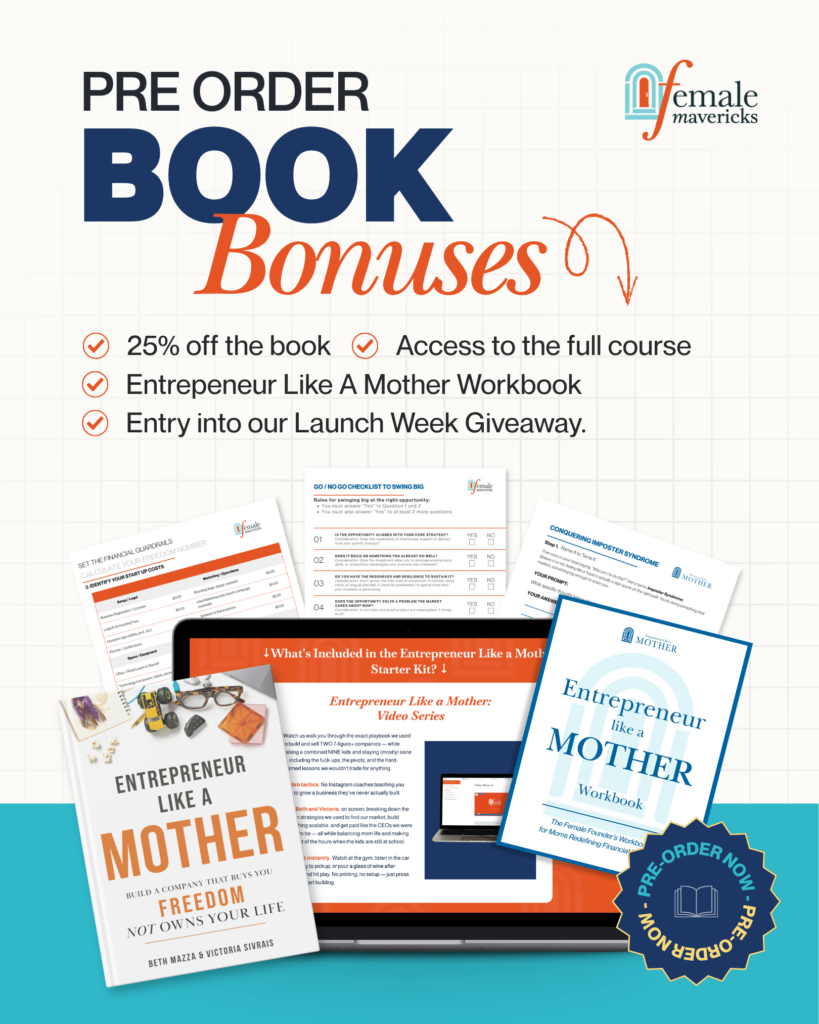
Entrepreneur Like a MOTHER is out September 22. Pre-order here:
We are still adding advance readers. If you want a copy now in exchange for an honest review at launch, send us an email or a DM! Feel free to quit at chapter 4.
P.S. If someone you know is in a hard week right now, forward this to her. No pep talk attached. Just this.