

Most founders price the risk of asking. Almost nobody prices the risk of staying quiet.
Early on, we built a spreadsheet of every person we knew. We exported our LinkedIn contacts, painstakingly scoured our email boxes (pre-AI of course) and added the membership rosters from the two or three organizations we somehow managed the time to be engaged with. Then we sorted the whole thing into three columns.
Easy to reach.
Long shot but worth trying.
Hail Mary pass.
The Hail Mary pass column was short. One name on it stayed there for six weeks.
She was a dynamite contact, two degrees out. She had spent the last decade running the exact organization we were about to build out on our own. We had a mutual contact that could make the introduction. So, we wrote the email. And then we did nothing with it. It just stayed in our draft emails and we looked at it every once in a while.
We told ourselves we were waiting until we had more to show her. That was not even close to true. We were terrified. We were protecting our vulnerable egos. As long as we did not ask, she stayed a possibility. Ask and get nothing back, and the possibility was gone.
That is a terrible trade, but one we knowingly made every day for six weeks.
What we were actually risking
There really was only one downside of that email. She would ignore it, and we would never hear from her. Admittedly, that was the most likely outcome by a wide margin.
She could also give us a polite no, and we would have taken our shot and missed it. That was the second most likely outcome.
Our worry was that she would say no and then think slightly less of us for asking. We might never know if she viewed our thoughtful, customized ask as a sloppy, generic overreach.
Worse, the mutual contact who made the introduction might be annoyed we spent a favor of hers and got nothing. That unfortunately happened to us more than once. It cost a small amount of goodwill with someone who already liked us.
For those of you doing the math at home, our worst realistic outcome was a spent favor and a bruised ego. The most likely outcome was silence.
That is the entire risk we spent six weeks avoiding. What were we thinking?
The cost of not sending it
This is the math almost nobody does. You never see it. Nobody invoices you for the client you did not pitch. There is no line item for the partnership you did not propose. The cost of inaction is real, it is recurring, and it’s hard to calculate it’s cost.
So we wrote the second column.
We were about to build a business line we didn’t know enough about. We would have staffed it wrong, priced it wrong, and figured that out eighteen months and a lot of payroll later. That was the actual alternative to the email. Not “we stay where we are.” Staying where you are is never the alternative. The alternative is that you solve the same problem the expensive way, alone, slower.
Once that sat next to “she might not reply,” it stopped being a hard decision.
We sent it, went out for lunch and promised each other we wouldn’t check our phones. We checked them a million times before she answered the next day. She agreed to coffee two weeks later, and proceeded to tell us three things in forty minutes that would have taken us a year and a half to learn by trial. The most we could do was buy her a latte and offer her a unicorn cake pop which she politely declined. Lucky us, she has been in our Kitchen Cabinet ever since.
Run both columns, every time
Linda Babcock’s research at Carnegie Mellon found that 57 percent of male graduates negotiated their first salary offer, against 7 percent of women. The same body of work found women reporting roughly two and a half times as much apprehension about negotiating. We don’t believe this is a confidence gap. We think the average woman just didn’t do the math we did, and press send.
Correcting it took about 5 seconds.
Column one: the ask fails. Write the specific worst realistic outcome. Not the catastrophic one, the realistic one. In nearly every case it is one of four things. No reply. A no. A small amount of spent goodwill. A slightly awkward next encounter.
Column two: you never ask. Write down what you will do instead, and what that costs. Build it yourself. Pay someone. Wait another quarter. Keep the underpriced client. Keep the employee who checked out in March. Each of those carries a number, and it is almost always the larger one.
Then compare the columns. And if you are still nervous, hand it to a trusted Kitchen Cabinet member and as them to do the comparison.
Where this shows up
Clients. The proposal you soften before sending. The scope you trim because you assume they will balk at the real number. For us,the realistic downside was one prospect telling us we were expensive. The cost of not asking was every future contract anchored to the old number.
Investors and buyers. Our first acquisition offer had the wrong structure, too much of the payout sat behind the close. Walking away and going back to the market felt like the riskiest thing we had ever done. The realistic downside is that we wouldn’t be able to sell our business for several years. The cost of not asking was 35 percent of the sale price, one year later.
Partners. Referral arrangements, joint pitches, channel relationships. Nearly every one starts with a note that felt presumptuous and pushy to the person writing it.
Employees. This one runs backward, and founders get it wrong most often. The hard conversation you are not having is not neutral while you delay. It costs you the team’s respect, the client’s patience, and eventually the person’s own time. The downside of the conversation is one bad afternoon, and yes, potentially some additional recruiting costs. The cost of not having it compounds every month.
What the email actually said
Four sentences. No deck, no overstatements, just a direct ask.
| Hi. We both know Grace. I’m launching a business segment that does X, and she said you have a lot of experience (and success) in the area. Could I pick your brain over coffee, at whatever time and place works for you? |
It works because it does three things at once. It borrows credibility from a shared name. It is specific enough that she knows exactly what she is being asked for. And it is small enough to say yes to in under a minute.
Most people like being treated as the expert. They will help if it’s not too hard. You literally only have one job. Make it easy.
Four rules we use now, all of them learned by getting them wrong first:
Stay in their wheelhouse. Never ask for an introduction unless you are certain the connection exists. Do the homework before you spend the favor.
Be specific. Not “smart people in retail.” A named person, or a description tight enough that they can picture one.
Time it right. Anything that takes more than three minutes of their time slips, then slips again. Anything under three minutes usually gets done that day.
Do not overreach. Their network was as hard to build as yours. Do not ask someone you barely know to spend it on you. Earn that first.
The part worth keeping
Some of our best relationships came from the least likely places. A mom in the school pickup line who offered to introduce us to her neighbor in the same business. A researcher we cold-called because we had read the paper. A woman from our university that graduated a few years ahead of us. Our banker’s sister.
None of those happened because we felt ready. They happened because someone sent something.
The email you are not sending is not free. You are paying for it every month with lost potential profits.
Write both columns. Then send it.
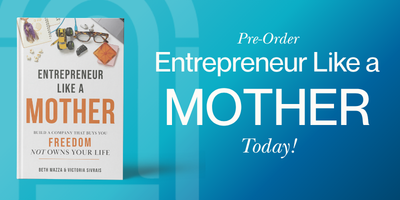
Building your Kitchen Cabinet is Power Move #2 in Entrepreneur Like a MOTHER, out September 22 from Wiley. The chapter covers the three types of people you need, how to find them when you are starting from a thin network, and how to ask so that people say yes.
P.S. If someone you know is in a hard week right now, forward this to her. No pep talk attached. Just this.
New here? Founders Files is a weekly letter for women building real businesses around real families. Subscribe to Founders Files here