

Two years after COVID nearly took the legs out from under us, Clermont Partners had its best year.
The ESG practice we had bet the farm on was finally paying. Retainers were up. New logos were signing. The pricing decision that had terrified us, moving our target from $90,000 a client to $150,000, had worked. Our margins were where we said they needed to be. On paper, it was the year everything we had built finally clicked.
It was also the year we ran completely out of gas.
Not the dramatic version that makes for a good LinkedIn post. The quiet version.

We were answering client email at 11 p.m. because that was the only uninterrupted block of time either of us had all day. We were taking calls from the car. The 4:45 train rule we had defended for years, the one where we left the office and went home no matter what was on fire, had stopped being a rule. It had become a thing we used to do.
Here is the part that made it worse. Nobody saw a problem. Revenue was up. Headcount was up. Anyone looking at our numbers would have told us we were crushing it. And they did.
The number everyone was congratulating us on was the number costing us the most.
Revenue tells you almost nothing
Revenue is the number people ask about at conferences. It is the number in the panel bio and the press release. It is the number women use to size each other up across a hotel lobby. On its own, it is close to meaningless.
Wells Fargo’s 2025 report on women-owned businesses counted 272,567 women-owned employer firms doing more than $1 million a year, producing $2.2 trillion in combined revenue. Impressive. Then look at the second half of the finding: those firms generate roughly half the revenue of comparable men-owned firms, and women make up only 13.7 percent of million-dollar-plus employers. We are very good at getting to a big top line. We are much less practiced at what happens underneath it.
In Chapter 9 of Entrepreneur Like a Mother we call this the entrepreneur’s hamster wheel. Revenue is up, and so are your hours, your stress, and your expenses. You are running faster to stay in place. The top line looks sexy, and we would know, because we lived it. The margins are paper thin or missing entirely. No breathing room, no owner distributions, and a nagging sense that something has to give.
That was our best year. A very expensive treadmill.
The problem was not that we were working hard. We have always worked hard. The problem was structural. Every additional dollar of revenue that year came with an additional hour of one of us attached to it. New clients meant we were in the pitch. Big clients meant we were on the account. The growth engine we had built ran on a fuel supply that was finite and non-renewable, which was our time.
Growing and scaling are not synonyms. Growing means working more hours for more money. Scaling means the profits go up while the workload goes down, because systems and people are carrying weight you used to carry personally. That distinction is the whole argument of Chapter 9, and we were on the wrong side of it in the best year of our careers.
The three numbers that actually matter
If we could hand our younger selves one page, it would be this one. Three numbers. Track them monthly. Let them, not revenue, decide what you say yes to.
1. Margin per hour of your personal time
Take your annual profit. Not revenue. Profit, after you have paid yourself a real market salary for the job you actually do. Divide it by the number of hours you personally put into the business. Count the 11 p.m. email hours. Count the Sunday hours. Count the mental hours in the pickup line.
The number that comes back is what your time in your own company is worth.
Most founders have never run this calculation, and the ones who do are usually quiet for a minute afterward. We have watched women with seven-figure businesses discover they are earning less per hour than the senior people they employ. That is not a character flaw. It is a design flaw, and design flaws are fixable.
Run it once a year at minimum. Watch which direction it moves. If revenue climbs and this number falls, you have not built a better business. You have bought yourself a more demanding job.
2. Monthly recurring income
Not annual revenue. What lands in the account every month whether or not you close a single new deal.
This one is not a soft metric. At Clermont it was a hard operating rule, and it is one of the financial nonnegotiables in Chapter 6, Power Move #3: expenses had to be covered by recurring revenue before we hired anyone. Project work is lumpy and unpredictable. Retainers are steady. We built the entire expense structure on the recurring base so that profitability held whether or not a big project landed that month. We broke that rule exactly once, deliberately, to fund the ESG buildout, and we did it with contingency plans in hand.
That rule did two things. It kept us out of the red. And it turned out to be one of the biggest drivers of what the business was ultimately worth, because buyers pay premiums for predictability. A business where revenue recurs is worth meaningfully more than one where every dollar has to be re-earned from scratch each January.
Here is the practical version. Add up your monthly recurring income. Add up your monthly fixed costs. If recurring does not cover fixed, you do not have a business yet. You have a very demanding sales job with employees attached.
3. What the business would sell for tomorrow
Not what you think it is worth. What a buyer would actually pay for it this month, given its current margins, its recurring base, its client concentration, and how much of it walks out the door when you do.
For most founder-run services firms, that number is a fraction of what the owner assumes. The Exit Planning Institute has been tracking this for years and their finding does not move much: the business typically represents 80 to 90 percent of the owner’s net worth, and only 13 percent of owners have a formal exit plan. Nearly all of your money is in an asset you have never had valued and have no plan to convert.
We know both sides of that gap personally. We sold our first firm, Ashton Partners, for roughly 1x revenue. We sold Clermont for approximately 6x. Same two founders. Same industry. Nine years apart.
The difference was not luck or a hot market. Ashton was a good business that we had never built with a buyer’s eyes on it. No recurring revenue story. No defensible niche. No growth engine. It sold for what it was worth that day. Clermont had a retained client base, a 30 percent margin target that forced the pricing change we were scared to make, and a high-growth service line launched years before we ever thought about selling.
The business that kill you
The year we made the most money, we were optimizing for the wrong number, and the cost showed up in our calendars and our bodies before it showed up on the P&L. Our accountant wasn’t going to flag it for us because our P&L looked great. This is exactly why revenue is such a dangerous metric to run a business on. It can keep going up while everything underneath it quietly degrades.
Three numbers. Margin per hour of your time. Monthly recurring income. What it would sell for tomorrow.
Run them this month. If they tell you something you do not want to hear, you are not behind. You are early.
The financial rules of engagement behind these numbers, including the pricing decision that changed our margins and the hiring rule that kept us out of the red for a decade, are in Chapter 6 of Entrepreneur Like a MOTHER: Build a Company That Buys You Freedom, Not Owns Your Life, Power Move #3: Make the Money Moves That Matter, by Beth Mazza and Victoria Sivrais. The growing versus scaling framework is Chapter 9. The Freedom Number exercise is Chapter 10.
Just do the math first. Ask the kid we had to call.
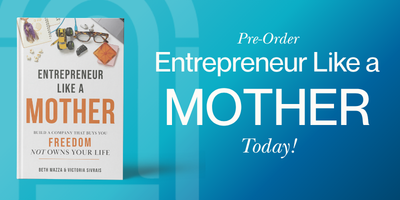
Entrepreneur Like a MOTHER is out September 22. Pre-order here:
P.S. If someone you know is in a hard week right now, forward this to her. No pep talk attached. Just this.
Sources
Wells Fargo, The 2025 Impact of Women-Owned Businesses (January 2025). smallbusinessresources.wf.com
Exit Planning Institute, State of Owner Readiness: Generational 2025 National Report. exit-planning-institute.org